
Not sure if your current insurance is enough? This guide explains how umbrella insurance works and when it can help protect what you’ve worked hard to build.
A serious accident or lawsuit can put much more than your car or home at risk. If you’re found responsible for damages that exceed the liability limits on your insurance policy, you could be responsible for paying the difference out of your own pocket. That could mean dipping into your savings, your home equity, future income, or other assets you’ve worked hard to build.
That’s where umbrella insurance comes in. It adds an extra layer of liability protection above the limits of your auto, homeowners, renters, or other eligible insurance policies. While most people never expect to need it, one major claim can quickly exceed the coverage included in a standard policy.
Whether you’re a homeowner in Atlanta, have a teen driver in the family, own a rental property, or simply want greater peace of mind, this guide explains how umbrella insurance works in Georgia, what it covers, who should consider it, and how to decide whether it’s the right fit for your situation.
Get Your Umbrella Insurance Quote
What is umbrella insurance?

Umbrella insurance is additional liability coverage that helps protect your finances when a covered claim exceeds the liability limits of your underlying insurance policies, such as your auto, homeowners, renters, landlord, or boat insurance.
Depending on the policy, umbrella insurance may help pay for:
- Injuries to other people
- Damage to someone else’s property
- Legal defense costs
- Court judgments and settlements
- Certain personal liability claims, such as libel or slander
It does not replace your existing insurance. Instead, it works alongside it, providing an extra layer of protection when your primary liability coverage has been exhausted.
How Umbrella Insurance Works in Georgia
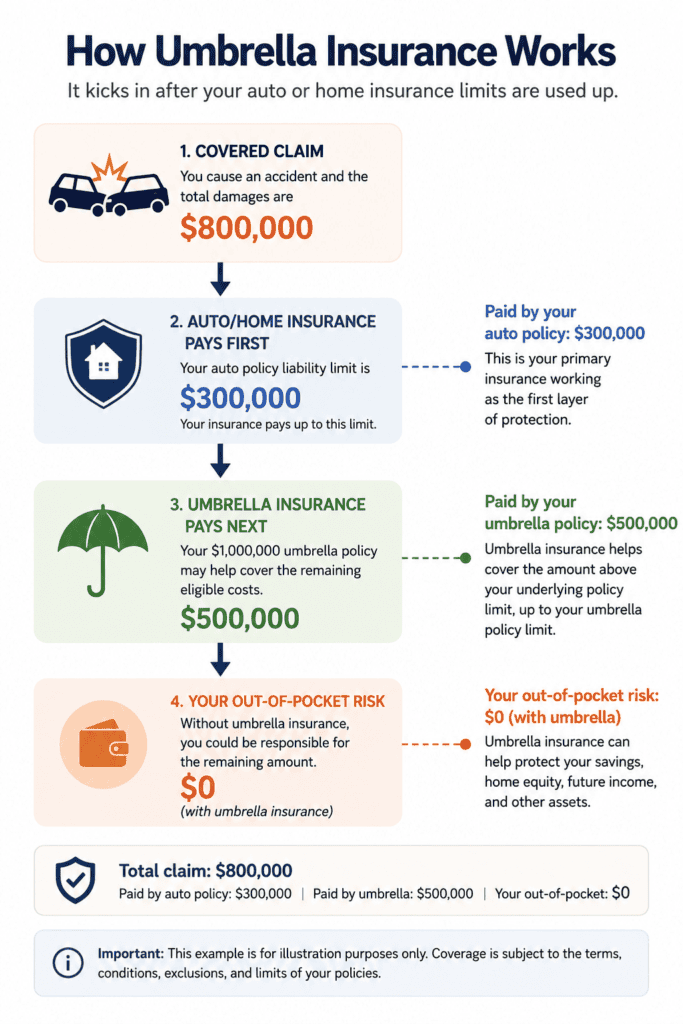
Umbrella insurance doesn’t replace your auto or homeowners insurance. Instead, it provides an extra layer of liability protection after the liability limits on your underlying policy have been exhausted.
Here’s how it works:
Let’s say you’re involved in a serious car accident in Georgia and are found responsible for injuries and property damage totaling $800,000.
Your auto insurance policy has a liability limit of $300,000, so your auto insurance pays that amount first. Without umbrella insurance, you could be responsible for paying the remaining $500,000 yourself.
If you have a $1 million umbrella policy, it may help cover the remaining eligible costs after your auto policy reaches its limit, protecting your savings and other assets from a potentially devastating financial loss.
| Without Umbrella Insurance | With a $1M Umbrella Policy | |
| Total covered claim | $800,000 | $800,000 |
| Paid by your auto policy | $300,000 | $300,000 |
| Paid by umbrella insurance | $0 | $500,000 |
| Your potential out-of-pocket cost | $500,000 | $0* |
*Assumes the claim is covered under both the underlying policy and the umbrella policy. Coverage is subject to policy terms, conditions, exclusions, and limits.
Think of it like a safety net. Your auto or homeowners insurance is your first line of defense. Umbrella insurance is there to help protect your finances if a covered liability claim grows beyond what your primary policy can pay.
What Does Umbrella Insurance Cover?
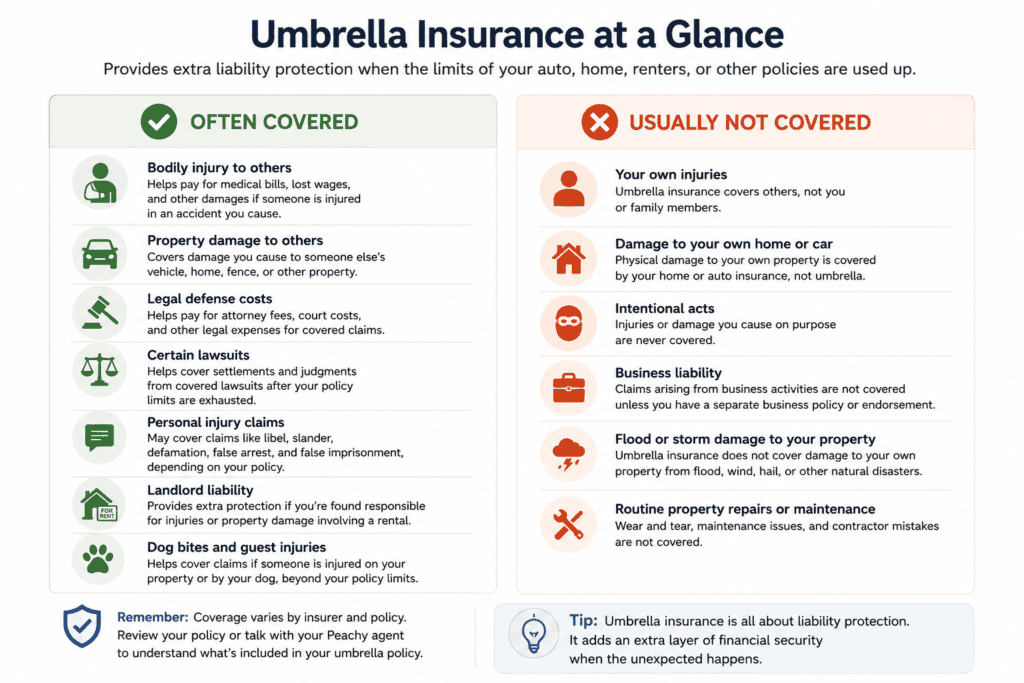
Umbrella insurance is designed to protect you when you’re legally responsible for causing injuries or property damage that exceed the liability limits of your underlying insurance policies.
While every policy is different, umbrella insurance may help cover a wide range of liability claims, giving you added financial protection when the unexpected happens.
Bodily Injury to Others
If someone is seriously injured because of an accident you’re responsible for, the medical bills, lost wages, and other damages can quickly exceed the liability limits on your auto or homeowners policy.
For example, if you’re involved in a major accident on I-285 or another busy Georgia highway and the injuries result in a large lawsuit, your umbrella policy may help cover the remaining eligible costs after your auto insurance reaches its limit.
Property Damage to Someone Else’s Property
Umbrella insurance may also help pay for damage you cause to someone else’s property once your primary liability coverage has been exhausted.
This could include damaging another vehicle, a neighboring home, a fence, or other valuable property.
Legal Defense Costs
If you’re sued after a covered incident, legal expenses alone can become expensive, even if the lawsuit never goes to trial.
Many umbrella policies help cover attorney fees, court costs, and other legal defense expenses related to covered claims. Depending on your policy, these costs may be covered in addition to your liability limit.
Certain Lawsuits
Not every liability claim ends with an insurance settlement. Some become lawsuits seeking significant financial damages.
Depending on the policy, umbrella insurance may help cover judgments and settlements resulting from covered lawsuits after your underlying insurance limits have been reached.
Personal Injury Claims
Many people don’t realize umbrella insurance may also protect physical accidents.
Some policies include coverage for certain personal injury claims, including:
- Libel
- Slander
- Defamation of character
- False arrest
- False imprisonment
Coverage varies by policy, so it’s important to review your specific coverage with your insurance agent.
Landlord Liability
If you own a rental property in Georgia, umbrella insurance may provide an extra layer of protection if you’re found legally responsible for injuries or property damage involving your rental.
For example, if a tenant or guest suffers a serious injury on the property and the claim exceeds your landlord liability limits, umbrella insurance may help cover the remaining eligible costs.
Dog Bites and Guest Injuries
Accidents at home can happen when you least expect them.
If a guest slips on your property or your dog injures someone, your homeowners insurance may provide liability coverage up to your policy limit. If the claim exceeds that limit, umbrella insurance may help cover the remaining eligible costs, depending on the circumstances and your policy.
Keep in mind: Umbrella insurance doesn’t expand every type of coverage. It provides additional liability protection for covered claims after the limits of your underlying policy have been exhausted. Coverage varies by insurer and policy. Review your policy documents or speak with your insurance agent to understand exactly what’s covered.
What Umbrella Insurance Usually Does Not Cover

Umbrella insurance provides an extra layer of liability protection. That’s an important distinction.
It isn’t designed to cover every loss you might experience. Instead, it helps protect you when you’re legally responsible for injuries or property damage to someone else and the liability limits on your underlying insurance policy have been exhausted.
Here are some situations that umbrella insurance typically does not cover.
Your Own Injuries
If you’re injured in an accident, umbrella insurance won’t pay for your medical bills or lost income.
Those expenses are generally covered by your health insurance, medical payments coverage, or other applicable insurance.
Damage to Your Own Property
Umbrella insurance doesn’t pay to repair or replace your own home, car, boat, or personal belongings.
For example, if a hailstorm damages your roof or your vehicle is damaged in an accident, your homeowners or auto insurance – not your umbrella policy – would typically respond.
Intentional Harm or Criminal Acts
Insurance is designed for accidents, not intentional wrongdoing.
If you intentionally injure someone or commit a criminal act that causes damage, umbrella insurance generally won’t provide coverage.
Business Liability
If you’re sued because of your business or professional activities, a personal umbrella policy usually won’t apply.
Business owners often need separate commercial liability insurance or a commercial umbrella policy for those risks.
Contract Disputes
Umbrella insurance isn’t intended to resolve disagreements over contracts or business agreements.
For example, if you’re involved in a dispute with a contractor over home renovations or another contractual obligation, those claims generally aren’t covered.
Flood, Storm, or Other Damage to Your Home
Many Georgia homeowners are surprised to learn that umbrella insurance doesn’t cover damage to their own property caused by hurricanes, severe storms, flooding, or fallen trees.
Those situations are handled through your homeowners insurance, flood insurance, or other property insurance, depending on the cause of the damage and your policy.
The Simple Way to Think About It
Umbrella insurance protects you from large liability claims. It doesn’t protect everything you own from every type of damage.
If you’re legally responsible for injuring someone or damaging their property, umbrella insurance may provide additional protection after your underlying policy reaches its limit.
If your own home, car, or belongings are damaged, you’ll typically look to your homeowners, auto, flood, or other property insurance instead.
Who Should Consider Umbrella Insurance in Georgia?
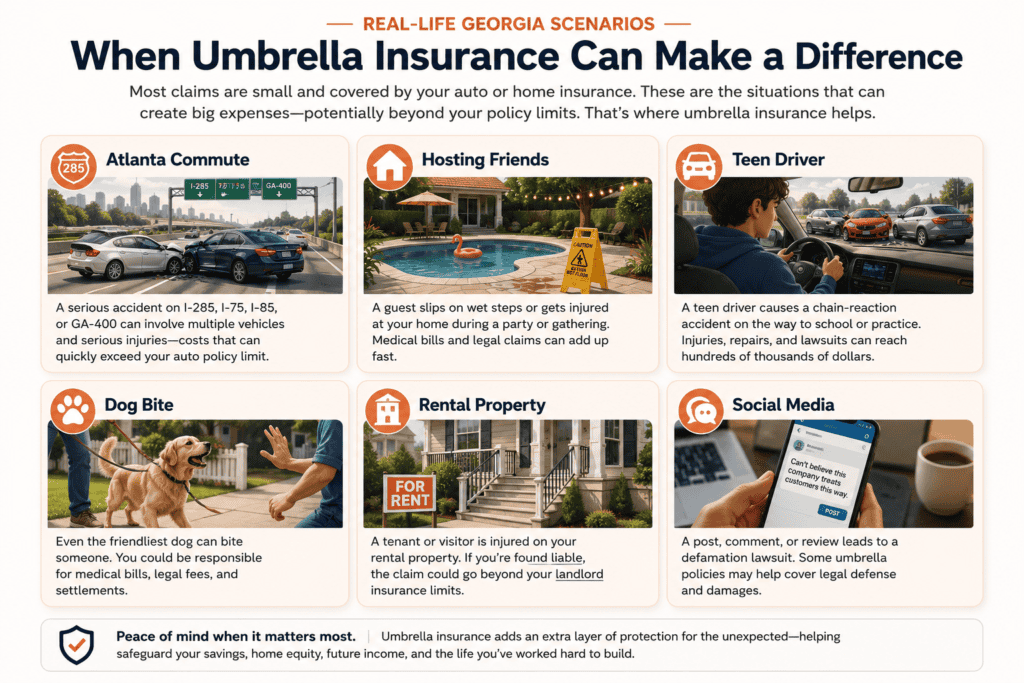
Umbrella insurance can make sense for anyone whose savings, income, or assets could be at risk after a major liability claim.
If any of the situations below sound familiar, it may be worth talking with your insurance agent about whether umbrella coverage is right for you.
Homeowners with Equity
Your home is often your largest financial asset. If you’re found liable for a serious accident or lawsuit, your savings and home equity could be at risk if your existing liability coverage isn’t enough.
Families with Teen Drivers
Teen drivers have less experience behind the wheel, which can increase the likelihood of serious accidents.
If your teenager causes an accident that results in significant injuries or property damage, umbrella insurance may provide additional protection once your auto policy reaches its liability limit.
Landlords
Owning rental property creates additional liability exposure.
If a tenant or guest is seriously injured on your property and you’re found responsible, an umbrella policy may provide extra protection beyond your landlord insurance liability limits.
Dog Owners
Even well-trained dogs can behave unpredictably.
If your dog bites someone or causes an injury, medical expenses and legal claims can quickly become expensive. Depending on the circumstances and your policy, umbrella insurance may help cover eligible costs that exceed your homeowners liability limits.
Homes with Pools or Trampolines
Pools, trampolines, and other backyard features can increase the risk of serious injuries.
If you frequently have children, neighbors, or guests visiting your home, an umbrella policy may provide valuable additional liability protection.
People Who Love to Host
Whether it’s a summer barbecue, a birthday party, or a holiday gathering, inviting people into your home also means accepting some level of liability.
If a guest is seriously injured on your property, the resulting claim could exceed the liability limits on your homeowners insurance.
People with Savings or Investments to Protect
You don’t have to be wealthy to benefit from umbrella insurance.
If you’ve spent years building savings, investing for retirement, or paying down your mortgage, an umbrella policy can help protect what you’ve worked hard to build if you’re faced with a large liability claim.
Drivers with Long Atlanta Commutes
If you spend a lot of time on busy roads like I-285, I-75, I-85, or GA-400, you’re simply exposed to more driving risk than someone who only makes occasional trips.
More time behind the wheel means more opportunities for accidents, making additional liability protection worth considering.
People Who Are Active Online
Social media has made it easier than ever for misunderstandings to become legal disputes.
Some umbrella insurance policies may provide coverage for certain personal injury claims, such as libel, slander, or defamation, giving you another layer of protection beyond physical accidents.
Is Umbrella Insurance Right for You?
You don’t need to check every box on this list.
For many Georgia families, one or two of these situations are enough to start the conversation. If you own a home, drive regularly, have savings to protect, or simply want more peace of mind, an umbrella policy may be worth considering.
The best way to know is to review your current liability limits and compare them with the assets and future income you’re trying to protect. A quick coverage review can help you decide whether an umbrella policy fits your needs.
How Much Umbrella Insurance Do You Need?

There’s no one-size-fits-all answer to this question.
The right amount of umbrella insurance depends on what you’re trying to protect, how much liability coverage you already have, and the level of risk you face in your daily life.
A good place to start is by looking at three things:
1. What Assets Are You Protecting?
Think about everything you’ve worked hard to build, including:
- Home equity
- Savings accounts
- Retirement and investment accounts
- Vehicles and other valuable property
- Future income
The more you have to protect, the more important it becomes to make sure your liability coverage keeps pace.
2. What Liability Coverage Do You Already Have?
Review the liability limits on your current insurance policies, including your:
- Auto insurance
- Homeowners insurance
- Renters insurance
- Landlord insurance
These policies are your first layer of protection. An umbrella policy is designed to provide additional liability coverage after those limits have been reached.
3. What Risks Do You Face?
Some lifestyles naturally come with greater liability exposure than others.
You may want to consider additional protection if you:
- Have a teen driver
- Own rental property
- Have a swimming pool or trampoline
- Own a dog
- Frequently entertain guests
- Spend a lot of time driving, especially around Metro Atlanta
- Have significant savings or investments
The more opportunities there are for a serious liability claim, the more valuable an umbrella policy may become.
A Simple Coverage Checklist
Use this table as a starting point to think about your personal situation.
| Consideration | Why Umbrella Insurance Matters |
| 🏡 You own a home | Your home equity may be at risk in a large liability lawsuit. |
| 💰 You have savings or investments | Additional assets may be exposed if a claim exceeds your liability limits. |
| 🚗 You drive frequently | More time on the road means more exposure to serious accidents. |
| 👨👩👧 You have a teen driver | Inexperienced drivers can increase liability risk. |
| 🏘️ You own rental property | Landlords often face additional liability exposure. |
| 🐕 You own a dog | Certain injuries can lead to expensive liability claims. |
| 🏊 You have a pool or trampoline | These features can increase the risk of guest injuries. |
How Much Does Umbrella Insurance Cost in Georgia?

Umbrella insurance is usually priced based on your personal risk profile so the cost can vary from one household to another.
As a general range, many $1 million umbrella policies cost a few hundred dollars per year, with higher coverage amounts increasing from there. Recent industry examples often place $1 million in coverage around $300 to $600 per year, depending on the household and insurer.
Your exact cost in Georgia will depend on factors like:
- Coverage amount: A $2 million umbrella policy will cost more than a $1 million policy.
- Homes, vehicles, and drivers: More property and more drivers usually mean more liability exposure.
- Teen drivers: Young drivers can increase risk, which may affect pricing.
- Prior claims: A claims history can influence eligibility and premium.
- Underlying policy limits: You may need to raise your auto or homeowners liability limits before qualifying.
- Rental properties or special risks: Landlord exposure, pools, trampolines, dogs, and similar risks may affect the quote.
The best way to know your cost is to review your current policies and request a custom umbrella insurance quote. That gives you a real number based on your coverage, your household, and your Georgia risk profile.
Umbrella Insurance vs. Raising Your Auto or Home Liability Limits

If you’re looking for more liability protection, you might wonder whether it makes more sense to increase the liability limits on your existing insurance policies or purchase an umbrella policy.
The answer is that these options often work together rather than replacing one another.
Increasing your liability limits gives you more protection within a specific policy, such as your auto or homeowners insurance. An umbrella policy adds another layer of liability coverage after those underlying policy limits have been exhausted.
What’s the Difference?
| Raising Liability Limits | Umbrella Insurance |
| Increases the liability limit on a single policy. | Provides additional liability coverage after your underlying policy reaches its limit. |
| Applies only to the policy you increase (such as auto or homeowners). | May provide additional liability protection across multiple eligible policies, such as auto, homeowners, renters, or landlord insurance. |
| Usually available up to the insurer’s maximum liability limits. | Typically begins after your underlying liability coverage has been exhausted. |
| May be the first step before considering an umbrella policy. | Often requires minimum underlying liability limits before you can purchase coverage. |
Do You Need Both?
In many cases, yes.
Most insurance companies require you to carry minimum liability limits on your auto and homeowners insurance before they’ll issue an umbrella policy. That’s because your primary insurance is designed to respond first, while the umbrella policy is intended to provide additional protection only after those limits have been reached.
For many Georgia homeowners and drivers, the process looks like this:
- Review the liability limits on your current policies.
- Increase those limits if needed to meet your insurer’s requirements.
- Add an umbrella policy for an extra layer of liability protection.
Rather than choosing one or the other, many people use both to build a more complete liability protection strategy.
Good to know: Every insurance company has its own eligibility requirements and minimum underlying liability limits for umbrella insurance. A coverage review can help you understand what’s required and whether an umbrella policy makes sense for your situation.
How to Get Umbrella Insurance in Georgia

If you’re considering umbrella insurance, getting started is usually straightforward. Here’s a simple process to help you determine whether it’s the right fit for your situation.
1. Review Your Current Liability Coverage
Start by looking at the liability limits on your existing insurance policies, including your:
- Auto insurance
- Homeowners insurance
- Renters insurance
- Landlord insurance (if applicable)
These policies provide your first layer of liability protection and are the foundation of an umbrella policy.
2. Take Inventory of What You’re Protecting
Think about the assets and future income you’d want to protect if you were faced with a large liability claim.
This may include:
- Your home and home equity
- Savings and investment accounts
- Retirement savings
- Vehicles and other valuable assets
- Future earning potential
3. Choose a Coverage Amount
There’s no universal amount that’s right for everyone.
Your insurance agent can help you compare your current liability limits with your assets and risk factors to recommend a coverage amount that fits your situation.
4. Confirm the Underlying Coverage Requirements
Most insurance companies require minimum liability limits on your auto and homeowners insurance before you can purchase an umbrella policy.
Your agent can review your current policies and let you know whether any adjustments are needed.
5. Review Your Policies Together
If you have multiple insurance policies, it may make sense to review them as a whole rather than individually.
Making sure your auto, homeowners, renters, or landlord policies work together with your umbrella coverage can help create a more complete liability protection plan.
6. Schedule a Coverage Walkthrough
A quick conversation with your insurance agent can help you understand your current liability limits, identify any potential coverage gaps, and determine whether an umbrella policy makes sense for your needs.
You don’t have to figure it out on your own.
Ready to Explore Your Options?
Whether you’re looking for added peace of mind or simply want to understand your current liability protection, we’re here to help.
Get a Custom Quote
We’ll review your current coverage, answer your questions, and help you decide whether umbrella insurance is the right fit for your situation.
FAQs About Umbrella Insurance in Georgia
Is umbrella insurance required in Georgia?
No. Georgia law doesn’t require drivers or homeowners to carry umbrella insurance.
However, many people choose to purchase it for additional financial protection if they’re concerned that a serious liability claim could exceed the limits of their existing auto, homeowners, renters, or landlord insurance.
Is umbrella insurance worth it?
It depends on your financial situation and your level of liability risk.
If you own a home, have savings or investments, drive frequently, own rental property, have a teen driver, or simply want additional peace of mind, umbrella insurance may be worth considering. The goal is to help protect your assets if a covered liability claim exceeds the limits of your primary insurance policies.
Does umbrella insurance cover car accidents?
Yes, in many cases.
If you’re responsible for a covered car accident and the damages exceed your auto insurance liability limits, umbrella insurance may help pay the remaining eligible costs after your auto policy has paid its maximum liability limit.
Does umbrella insurance cover dog bites?
It can.
If your homeowners insurance provides liability coverage for a dog bite claim and the damages exceed your policy’s liability limit, umbrella insurance may help cover the remaining eligible costs, depending on your policy and the circumstances of the claim.
Does umbrella insurance cover rental properties?
Many umbrella policies can provide additional liability protection for eligible rental properties.
If you’re found legally responsible for injuries or property damage involving your rental property and the claim exceeds your landlord policy’s liability limits, your umbrella policy may help cover the remaining eligible costs.
Does umbrella insurance cover flood or storm damage?
No.
Umbrella insurance generally doesn’t cover damage to your own home or personal property caused by floods, hurricanes, hail, wind, or other storms. Those losses are typically handled through homeowners insurance, flood insurance, or other property insurance policies.
Do renters need umbrella insurance?
Some renters choose to purchase umbrella insurance, especially if they have significant savings, investments, valuable future earning potential, or other assets they’d like to protect.
Because umbrella insurance focuses on liability rather than property ownership, you don’t have to own a home for it to be worth considering.
How much umbrella insurance should I have?
There’s no universal answer.
The right amount depends on your assets, your current liability limits, and your personal risk factors. Reviewing your insurance policies with an agent is the best way to determine how much coverage makes sense for your situation.
Can I buy umbrella insurance without auto or home insurance?
Usually not.
Most insurance companies require you to have an underlying policy, such as auto, homeowners, renters, or landlord insurance, before you can purchase umbrella coverage. They also typically require minimum liability limits on those policies.
Is umbrella insurance the same as excess liability insurance?
Not exactly.
While both provide additional liability protection, they’re not always the same.
An excess liability policy generally increases the limit of a specific underlying policy, while an umbrella policy may provide broader liability protection across multiple eligible policies and, in some cases, cover certain claims that aren’t included in the underlying policy.
The exact coverage depends on the insurer and the policy you choose.
Does umbrella insurance cover legal fees?
Many umbrella insurance policies help cover legal defense costs for covered liability claims. Depending on the policy, attorney fees, court costs, and other legal expenses may be covered in addition to, or as part of, your liability limit. Always review your policy to understand how legal defense costs are handled.
Still Not Sure if Umbrella Insurance Is Right for You?

Choosing the right amount of liability coverage isn’t always straightforward, and every household is different.
Whether you’re buying your first umbrella policy or want to understand if your current coverage is enough, we’re here to help.
Our team can review your existing policies, explain your liability limits in plain English, identify potential coverage gaps, and help you decide whether an umbrella policy fits your needs and budget. No pressure. Just honest guidance to help you make an informed decision.
Let’s review your current coverage together and answer your questions, so you can feel confident you’re protecting what matters most.