

Becoming a landlord changes your insurance needs in ways most people don’t realize until they file a claim, and it’s too late.
Most new landlords make the same assumption: their existing homeowners policy will cover the rental. It won’t. And the difference between the right policy and the wrong one isn’t a technicality that only matters in the fine print. It’s the difference between a covered claim and a denied one at the exact moment you need your insurance most.
Whether you’ve just signed your first lease, or you’re thinking about adding a second property, here’s what you need to know about insuring a rental before something goes wrong.
A landlord policy and a homeowners policy are not the same thing

This is the most important thing to understand, and it’s the one most new landlords get wrong. A standard homeowners policy is designed for an owner-occupied home, meaning you live there. The moment you rent it out, you’ve changed the risk profile in ways your homeowners policy may not cover.
A landlord policy, also called a dwelling fire policy or rental property policy, is built specifically for non-owner-occupied properties. The coverage is structured differently in two important ways.
First, personal property coverage is more limited. A homeowners policy typically covers your contents at 50 to 70 percent of the dwelling value. A landlord policy only covers items you keep on site that belong to you, appliances, equipment in a shed, or furnishings if you’re renting a furnished unit. Your tenant’s belongings are not covered under your landlord policy at all.
Second, liability works differently. A homeowners policy covers you and your household members, plus guests visiting your home. A landlord policy extends liability more broadly to account for the fact that strangers, your tenants, their guests, and their dogs are now regularly present on a property you own but don’t occupy.
If you haven’t told your insurance company you’re renting the property out, you may not have the right policy. And if you file a claim and they discover the property was rented when you had a homeowners policy, they may deny it.
The three coverages new landlords most often skip, and why each one matters

Beyond having the right policy type, there are specific coverage options that come up repeatedly when we talk to landlords who’ve had a hard experience.
Loss of rental income coverage is the one we see skipped most often. This coverage kicks in when a covered claim makes the property uninhabitable and your tenants can’t live there during repairs. If the roof is damaged in a storm and repairs take two months, you still have a mortgage to pay. Without loss of rental income coverage, you’re paying that mortgage with no rental income coming in. If rental income is part of how you cover your costs, or part of your income, this is not optional.
Higher liability limits are something most new landlords underestimate. You are now responsible for a property where people you didn’t choose, whose guests you don’t control, are living day-to-day. The handrail scenario is real: a tenant tells you it’s loose, you haven’t gotten to it yet, and their guest falls. Because you were made aware of the issue and didn’t fix it, your liability exposure is significant. Minimum liability limits that were fine for a homeowners policy may not be adequate for a rental.
An umbrella policy is worth serious consideration from the first rental property. Umbrella policies provide a layer of liability coverage above and beyond your underlying policy limits, and they’re generally more affordable than most people expect, often just a few dollars a day. The moment you become a landlord, your risk exposure increases in ways that are genuinely hard to predict. An umbrella policy is the tool that protects you from the scenarios that are difficult to anticipate.
What tenant damage actually looks like from an insurance standpoint
Insurance is designed to cover things that are sudden, accidental, and unpredictable: fires, burst pipes, lightning strikes. Tenant damage sits in a different category, and this is where landlords often expect coverage they don’t have.
If a tenant punches a hole in the drywall, leaves scorch marks from cooking, or causes water damage from neglect, those are real costs. But whether they’re covered by insurance depends on whether they meet that threshold of sudden and accidental, and whether you can actually prove what happened and who caused it.
Many tenant damage situations fall under the deductible anyway. If your deductible is $2,500 and the damage estimate is $1,800, that’s a security deposit conversation, not an insurance claim. Filing a claim for something under your deductible also affects your future premiums, so it’s worth thinking carefully before filing.
The single best thing you can do to protect yourself is documentation. Take detailed photos and video of every room before a tenant moves in and immediately after they move out. This gives you a documented baseline if you ever need to make a case to an insurance company or in court.
If you’re in the Southeast, these risks deserve extra attention
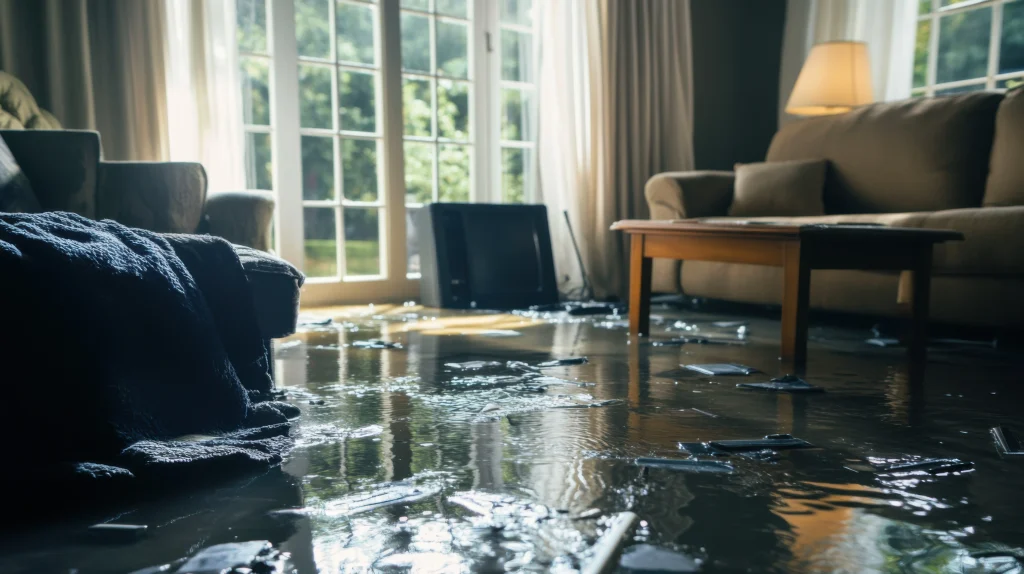
Landlords in Georgia, Florida, and the broader Southeast face weather-related risks that can be much more significant than they appear when you’re shopping for a policy.
Hurricane deductibles work differently from standard deductibles. Instead of a flat dollar amount, hurricane deductibles are typically calculated as a percentage of the insured dwelling value, often two to five percent. On a $300,000 property, a three percent hurricane deductible means you’re responsible for the first $9,000 of any hurricane-related damage before insurance kicks in. That’s not a small number, especially if you’re a new landlord who doesn’t yet have significant reserves.
Flood is excluded from both homeowners policies and landlord policies as a standard matter. If your rental property is in an area with flood risk, and in the Southeast, that covers a lot of ground, a separate flood insurance policy for the structure is not optional. Just a few inches of water can cause tens of thousands of dollars in damage, and without flood coverage, that comes out of your pocket entirely.
Vacancy is another risk that hits Southeast landlords particularly hard. In the humid summer months, a property that sits vacant without regular inspections can develop mold or water intrusion issues quickly. Many policies will exclude damage that results from an extended vacant property. If you have any gap between tenants, check in on the property regularly, and make sure your policy doesn’t have a vacancy exclusion that could catch you off guard.
What to require from your tenants

Requiring your tenants to carry renters insurance is one of the most effective ways to reduce your own liability exposure. A renters insurance policy includes liability coverage for the tenant, which means if something they do causes damage or injury, their insurance is the first line of response, not yours.
Renters insurance also covers your tenant’s belongings, which means they’re less likely to look to you if their laptop is stolen or their clothes are ruined in a water leak. Your landlord policy would typically cover neither situation, but tenants who don’t have their own insurance may not understand that and may expect you to make them whole.
Put the renters insurance requirement in the lease. Ask for proof of coverage before the tenant moves in and ask to be listed as an additional insured party so you’re notified if the policy lapses.
Short-term rentals and property managers: how coverage changes

If you’re using a property manager, verify that they carry their own liability insurance before you sign anything. Property managers are responsible for inspections, maintenance coordination, and tenant relationships, and mistakes in those areas can be costly. If they’re not insured and something goes wrong, you may be the one holding the bill.
Short-term rental platforms like Airbnb introduce a different set of coverage considerations. Many standard landlord policies explicitly exclude short-term rentals, and the liability exposure from a property being used for parties or large gatherings is meaningfully higher than a traditional long-term rental. If you’re renting short-term, talk to your agent specifically about whether your policy covers it; don’t assume.
The question worth asking your agent before you buy a policy

Most people buy insurance and never ask about the gaps- the specific scenarios that wouldn’t be covered. Before you finalize any landlord policy, ask directly: what could cause a claim to be denied? What situations are excluded from this policy?
The answers are usually things like extended vacancies, short-term rentals, dogs on the property without disclosure, or failure to maintain the property. Those aren’t edge cases. They’re real scenarios that come up for landlords regularly. Knowing about them in advance lets you either adjust the policy or take steps to mitigate the risk.
Landlord insurance isn’t complicated, but it does require a conversation with someone who understands what being a landlord actually looks like. If you’d like to talk through what coverage makes sense for your rental property, reach out to our team at Peachy Insurance. We can walk you through exactly what you need and make sure there aren’t any surprises if you ever have to file a claim.

What sets Carissa apart is her focus on the full picture. While a lot of the industry fixates on signing new customers, she has always believed that keeping people well-served matters just as much. Her work has centered on training the people who talk to customers, improving the processes that affect everyday interactions, and making sure nothing falls through the cracks.
She holds an MBA from the University of Georgia Terry College of Business and is a certified Project Management Professional (PMP®). Outside of work, she loves spending time on Florida's gulf coast, trying new restaurants, cooking, and making memories with her nieces and nephews. She is also a lifelong Survivor and The Challenge fan, and is always ready to debate the greatest competitors of all time.
- What First-Time Homebuyers Don’t Know to Ask About Their Insurance - September 23, 2026
- Flood Insurance: What Your Home Policy Doesn’t Cover and Why It Matters More Than You Think - August 23, 2026
- The Landlord’s Guide to Property Insurance: What You Actually Need and What You’re Probably Missing - August 23, 2026
