

Buying your first home is one of the most exciting things you’ll ever do. The insurance part doesn’t have to be stressful, but there’re a few things worth knowing before you get to the closing table.
If you’re in the middle of buying your first home, you already know how much is happening at once. There are inspections, appraisals, loan documents, moving logistics, and a seemingly endless list of things your lender needs from you.
Insurance is one more item on that list, and because it often comes up late in the process, it rarely gets the attention it deserves.
We work with first-time homebuyers every day at Peachy Insurance, and the questions that come up after closing are almost always the same: Why is my deductible so high? Does my policy cover that? What do you mean flood is separate?
This article is here to answer those questions before closing, so you can make informed decisions when there’s still time to change them.
Your lender’s insurance requirements and your actual coverage are two different things

Here’s something that surprises a lot of new buyers: when your lender tells you what insurance you need, they are describing the minimum requirements to satisfy your loan, not everything your policy should cover.
Your lender wants to know that the home is insured at a level that protects their collateral. That’s a reasonable thing for them to care about. But it doesn’t tell you anything about your deductibles, your water damage coverage, your liability protection, or whether you’re insured for the right amount if something major happens.
The policy that satisfies your lender may not be the policy that protects you. Those are not always the same thing, and understanding the difference is the most important thing a first-time buyer can do.
The deductible conversation nobody has at closing

Deductibles are where we see the most surprises. A homeowners policy often has more than one deductible, and most first-time buyers don’t know that until they file a claim.
The all other perils deductible is the one most people are aware of. It covers most everyday claims: a tree falls on your roof, a pipe bursts, a break-in. This is often a flat dollar amount, something like $1,000 or $2,500.
But in Georgia, Tennessee, Mississippi, and Arkansas, there’s frequently a separate deductible for wind and hail damage. This one isn’t usually a flat dollar amount. It’s calculated as a percentage of your dwelling coverage, typically one to two percent, but sometimes higher. On a $600,000 home, a two percent wind and hail deductible means you’re responsible for the first $12,000 of any wind or hail claim before your coverage kicks in.
We had a client here at Peachy who came to us after a storm caused significant damage to her home. She had bought her policy the previous spring during a rushed closing. She thought her deductible was $1,000. It was, for most claims. But the damage was wind-related, and her wind and hail deductible was two percent of her dwelling value, which came to roughly $12,000. She was out of pocket for more than she expected, because nobody had walked her through the difference.
Ask your agent specifically: how many deductibles do I have, what are they for, and what are the actual dollar amounts? It’s a five-minute conversation that can save a significant amount of money when something goes wrong.
Insuring for the right amount: market value versus replacement cost
Lenders and insurance companies think about the value of your home differently, and this creates a common point of confusion.
Your lender is thinking about market value, what your home is worth in the current real estate market, which is also roughly what your loan covers. Your insurance company is thinking about replacement cost, what it would actually cost to rebuild your home from the ground up if it were destroyed. These numbers are often different, and replacement cost is usually higher.
If your home is insured for less than it would cost to replace it, you may not have enough coverage to fully rebuild after a major loss. If it’s insured for significantly more than replacement cost, you’re paying for coverage you can’t actually collect. Getting the number right matters.
The way to get there is through a replacement cost estimator, a tool insurance companies use to calculate the true rebuild value based on square footage, construction materials, features, and local labor costs. At Peachy, we walk through this with every new buyer. Once you have that number, sharing it with your lender is actually helpful; it demonstrates exactly how the insurance company valued the property and often speeds up the approval process.
One more important detail on the lender side: make sure your mortgagee clause and loan number are accurate on your policy. Your mortgage company is listed on your policy as an interested party, and this information needs to be correct both for your closing and for the following year when the premium needs to be paid. Most homeowners have their insurance paid through escrow, which means the mortgage company pays it automatically, but only if they have the right information on file.
Water damage: one term, very different coverage

Water damage is one of the most misunderstood areas of homeowners insurance, especially in the Southeast where thunderstorms are frequent, and flooding is a real concern.
How water gets into your home determines which coverage applies, and whether you’re covered at all. A pipe bursting inside your home is a standard homeowners claim. Your sump pump failing or sewage backing up into your home may or may not be covered depending on whether you have water backup coverage added to your policy. A nearby creek overflowing its banks and sending water into your home is a flood claim, and standard homeowners insurance does not cover flooding.
These are three different events, and they’re handled three different ways. It’s a conversation worth having specifically with your agent before you close so you know exactly where your coverage begins and ends.
Flood insurance: what it is, when you need it, and what it costs at closing
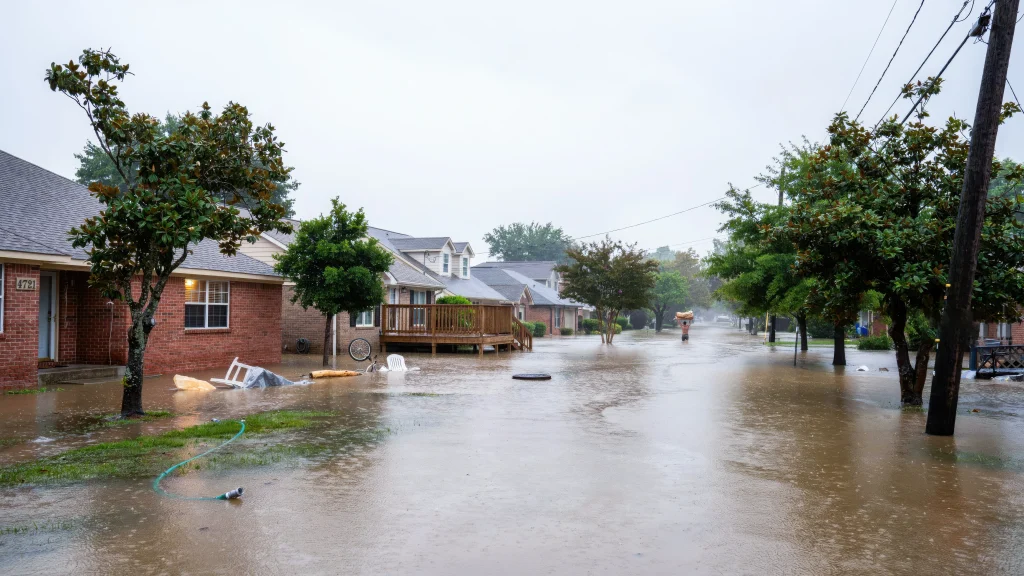
If your home is in a flood zone, your lender will require you to purchase a separate flood insurance policy. But even if it isn’t required, flooding is worth thinking about, especially in Georgia, Tennessee, Mississippi, and Arkansas, where intense thunderstorms can send water into homes that have never flooded before.
Standard homeowners insurance does not cover flooding. Flood insurance is a separate policy, and it needs to be purchased separately.
There’s one practical thing every new buyer should know: both your homeowners policy and your flood insurance policy are typically paid upfront at closing. This can add several thousand dollars to your closing costs that buyers sometimes don’t anticipate. Factor this into your budget early, ideally before you’re a week out from closing, and the number surprises you.
Liability coverage: the part of your policy most buyers forget about

You’ve spent a lot of time thinking about the structure of your home, the roof, the walls, the contents inside. But one of the most important parts of your homeowners policy has nothing to do with the physical structure. It’s liability coverage, and it protects you if someone is injured on your property and holds you responsible.
Slip on your icy front steps. Fall on your deck. A dog bite. These are all situations where a homeowner can face significant financial exposure. Liability coverage is what stands between you and a lawsuit that follows you for years.
Minimum liability limits are often not enough for the risk a home represents. As you review your policy, pay attention to your liability limit and ask whether it reflects what you actually have to protect. If you want an additional layer of coverage above and beyond your policy limits, an umbrella policy is worth discussing; it provides broader protection at a relatively low cost.
If you already have insurance with Peachy, call us before closing

If you’re already a Peachy customer with auto insurance, renters insurance, or another policy, give us a call before you finalize your home coverage. Multi-policy discounts can be meaningful, and adding a homeowners policy to an existing account is often faster and simpler than starting from scratch with a new company.
At Peachy, we communicate directly with your lender to make sure they have everything they need for a smooth closing. If you’re feeling the time pressure that comes with most home purchases, that’s exactly what we’re here for.
One call before or after closing can make a real difference
Whether you bought your policy yesterday, one week ago, or one year ago, it’s worth a conversation with your agent to make sure the coverage is right. The biggest purchase of your life deserves more than the minimum coverage that satisfied your loan officer.
Ask about all your deductibles, not just the standard one. Ask how your home’s value was calculated and whether replacement cost is where it should be. Ask about water damage, flood coverage, and what your liability limits actually look like. These questions aren’t complicated, but the answers matter enormously if something goes wrong.
We’re here to help you understand what you have, make sure it’s right for your situation, and fill in any gaps before they become problems. Reach out to our team at Peachy Insurance, and we’ll walk through your coverage together.

What sets Carissa apart is her focus on the full picture. While a lot of the industry fixates on signing new customers, she has always believed that keeping people well-served matters just as much. Her work has centered on training the people who talk to customers, improving the processes that affect everyday interactions, and making sure nothing falls through the cracks.
She holds an MBA from the University of Georgia Terry College of Business and is a certified Project Management Professional (PMP®). Outside of work, she loves spending time on Florida's gulf coast, trying new restaurants, cooking, and making memories with her nieces and nephews. She is also a lifelong Survivor and The Challenge fan, and is always ready to debate the greatest competitors of all time.
- What First-Time Homebuyers Don’t Know to Ask About Their Insurance - September 23, 2026
- Flood Insurance: What Your Home Policy Doesn’t Cover and Why It Matters More Than You Think - August 23, 2026
- The Landlord’s Guide to Property Insurance: What You Actually Need and What You’re Probably Missing - August 23, 2026
