

An insurance claim is a request for an insurance company to help pay for a loss or expense that may be covered by a policy. Once you file, the insurer reviews what happened, checks the policy, and decides what it can pay.
Say you come home to water spreading across the kitchen floor. You shut off the water and take a few photos. Once you’ve dealt with the immediate mess, you’ll want to know whether your home insurance might help with repairs and what to do next.
This guide walks you through those steps for both home and auto claims, from checking which coverage may apply to understanding the insurer’s decision.
When Does an Insurance Claim Apply?
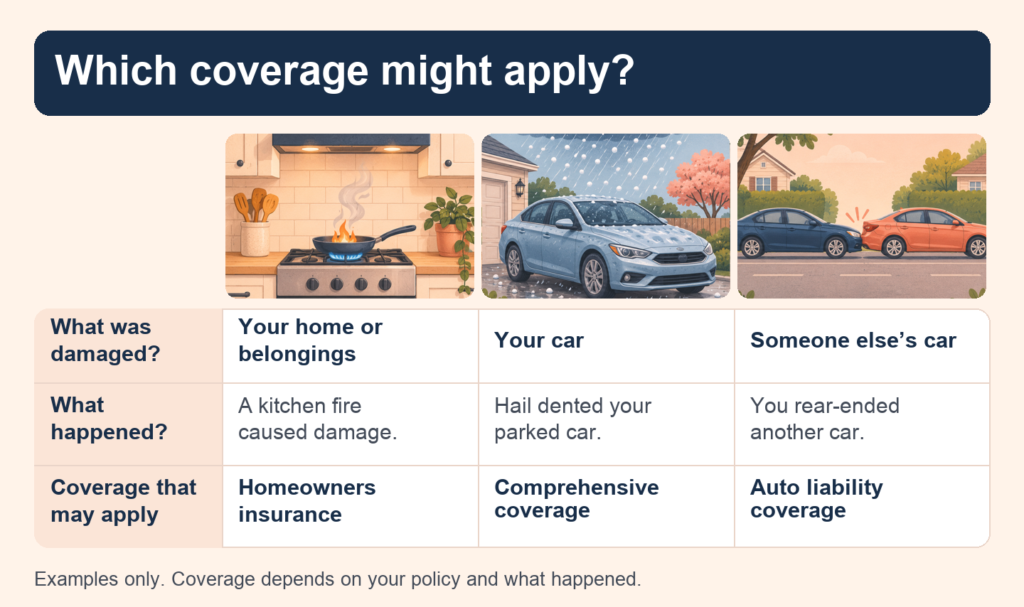
Two details help you figure out which coverage may apply: what caused the damage and whose property was damaged or who was hurt. Here’s how that plays out in a few common situations.
Damage to your home or belongings. A homeowners policy may help pay for damage from a sudden burst pipe or a kitchen fire. In the kitchen example, where the water came from matters. If it rose from an overflowing creek, you’d typically need separate flood insurance. If you rent, your renters policy may help replace belongings damaged by a covered event, while the landlord generally handles damage to the building. Peachy’s guide to common coverage gaps explains why those distinctions matter.
Damage to your car. If hail dents your parked car or someone steals it, comprehensive coverage may help. If your car is damaged in a crash, collision coverage may help pay for repairs. Check which coverages you carry for the car involved.
Injury or damage to someone else. If you cause a crash and damage another driver’s car, your auto liability coverage may help pay for their covered losses. If a guest is injured at your home and says you’re responsible, your homeowners liability coverage may apply. Let your insurer know promptly if someone is making a claim against you.
If another driver may be responsible for damage to your car, you can typically contact their insurer. You may also be able to use your own collision coverage, if you carry it, and your deductible generally applies if you go that route. Let your own insurer know promptly, even if you’re seeking payment from the other company.
If you’re weighing a small repair against your deductible, start with Peachy’s guide to deciding whether to file a claim.
How to File an Insurance Claim
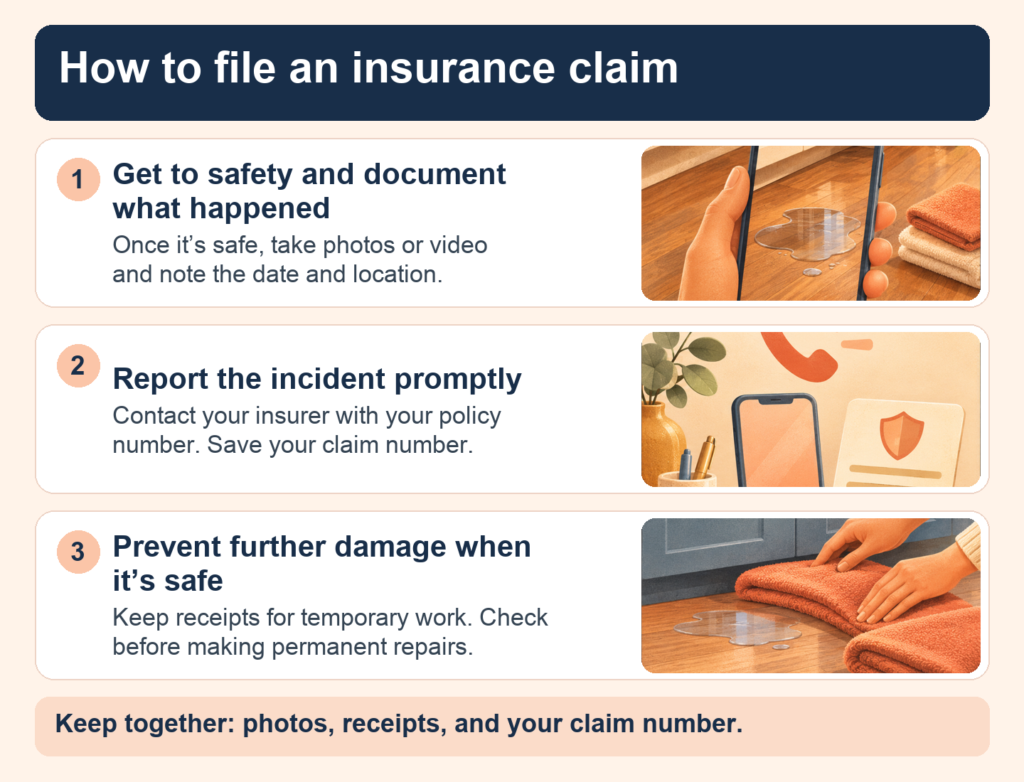
You don’t need to have every answer before you call. The steps below walk you through what to document once it’s safe, what to share when you contact your insurer, and how to keep the damage from getting worse.
1. Get to Safety and Document What Happened
Take care of people first. Call 911 if anyone is injured or in immediate danger. Once it’s safe, take photos or video and jot down when and where it happened and what you saw. If it’s a crash, exchange contact and insurance details and save the police report number if there is one. At home, start a list of damaged belongings and set aside any receipts you already have.
2. Report the Incident Promptly
Call your insurer’s claims line or report the incident through its app or website. Use the details you gathered in Step 1 to explain what happened.
What to Have Handy When You Report the Claim
- Your policy number.
- A brief description of what happened, including when and where it happened and what was damaged.
- Any photos, receipts, or report numbers you already have.
Ask what else your insurer needs and when it’s due. Save your claim number and your contact’s name so you know where to turn if you have an update or a question.
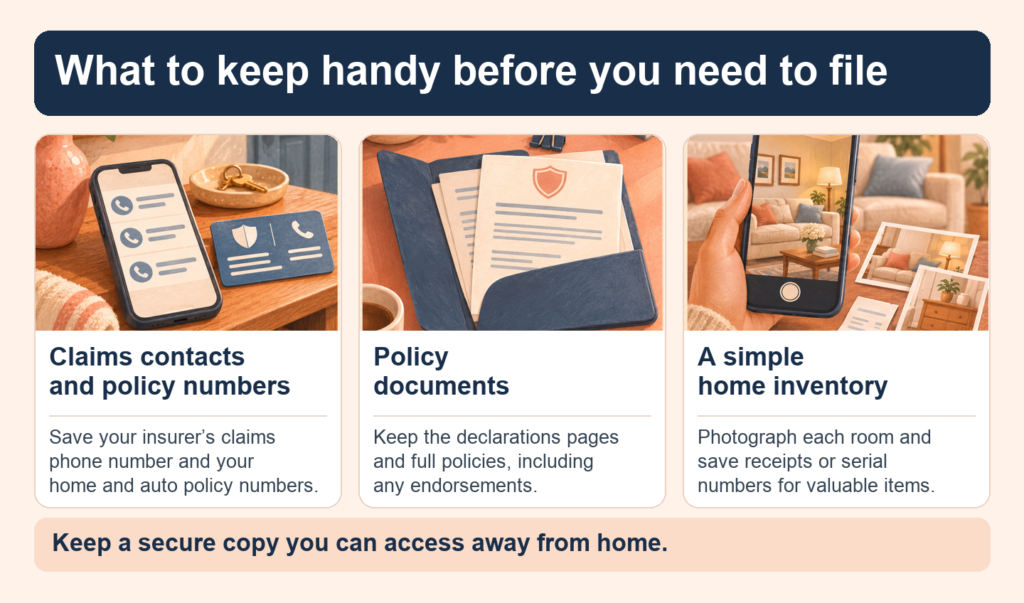
Pro tip: Save your insurer’s claims contact, policy numbers, and policy documents somewhere secure that you can access from your phone. For home insurance, a room-by-room photo or video inventory, along with receipts or serial numbers for valuable items, can help you document what you lost.
3. Take Reasonable Steps to Prevent More Damage
Once everyone is safe, take reasonable steps to keep the damage from getting worse. For example, if a pipe is leaking, shut off the water if you can safely reach the valve. Take photos of the damage and keep receipts for any temporary work. Check with your insurer before making permanent repairs or throwing damaged items away so you know what it needs to inspect or document. For more on documenting damage at home, see the NAIC’s guide to filing a homeowners claim.
What Happens Once Your Claim Is Underway
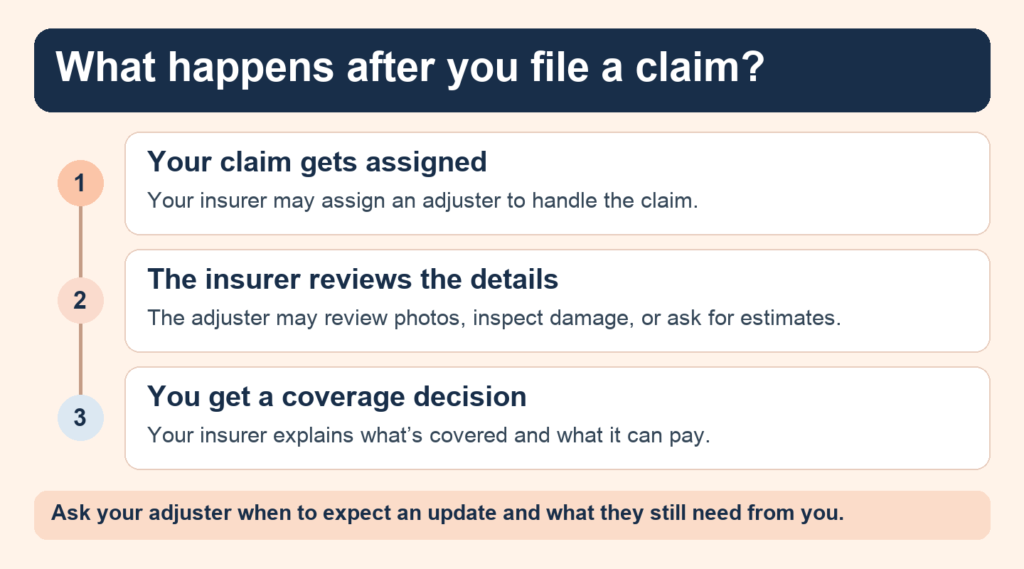
Once you’ve reported the damage, the insurer may assign a claims adjuster. This is the person who gathers the details, looks at the damage, and helps determine what your policy will pay. For a wet kitchen floor, that might mean reviewing your photos or arranging an inspection. If a contractor later finds damage under the flooring, share the updated estimate with your adjuster before approving the extra work, when possible.
Ask your adjuster when to expect an update and whether anything is still needed from you. A claim the adjuster can review from photos may move faster than one that needs an inspection or an investigation into who caused a crash.
The timing also depends on the information available and applicable state rules. If the insurer approves a payment, ask for a written breakdown so you can see how it calculated the amount.
How an Insurance Claim Payment Is Calculated
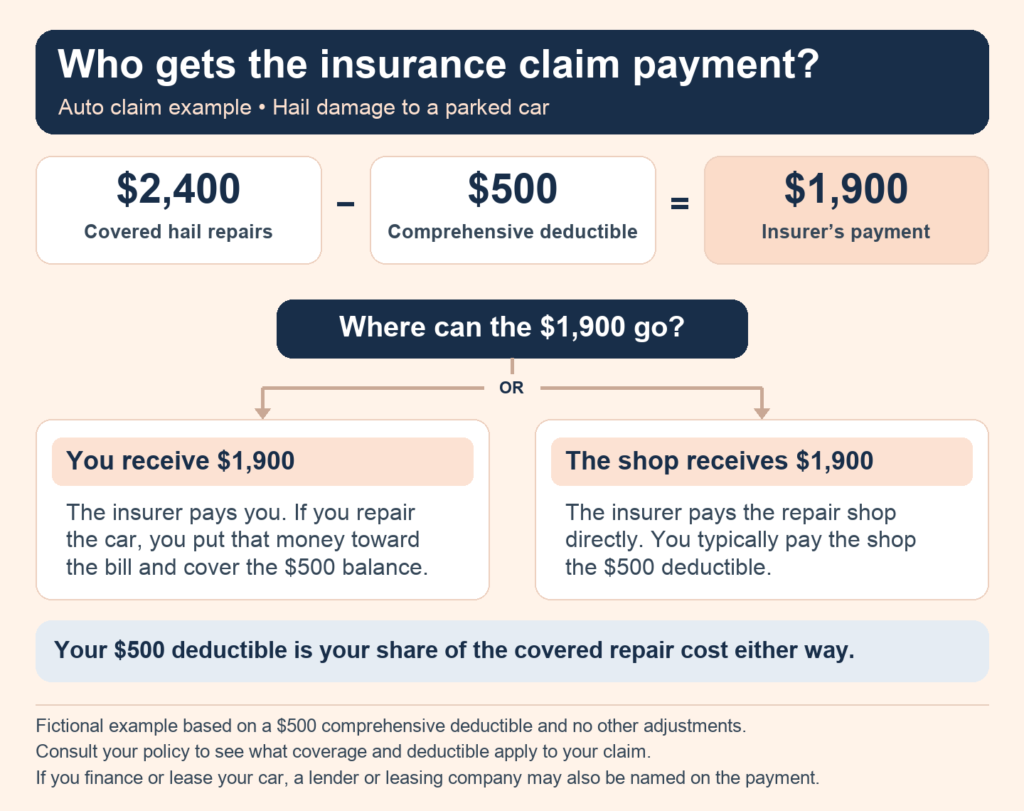
For a covered claim, your insurer works out the value of the covered damage or loss, applies any deductible you’re responsible for, and pays up to the applicable policy limit. A deductible is your share of the covered cost. A policy limit is the most your insurer will pay under that coverage. The policy’s terms also determine how the insurer values the loss, including whether it accounts for age and wear.
Say hail dents your parked car and your insurer approves $2,400 in covered repairs. With a $500 comprehensive deductible and no other adjustments, the insurer’s share would be $1,900. If it pays the shop directly, you’d typically pay the shop your $500 share. If it pays you and you go ahead with the repairs, you’d put the $1,900 toward the bill and cover the balance.
The same factors can play out differently on a home claim. If water ruins a rug, for example, an actual cash value policy generally accounts for the rug’s age and wear. Replacement cost coverage bases payment on the cost of a comparable new rug, subject to your policy. The insurer may pay part upfront and ask for a receipt before paying the eligible balance.
If a home claim check also names your mortgage company, ask your mortgage servicer how and when it releases money for repairs. The Consumer Financial Protection Bureau’s guide to home insurance payments explains how that can work. Whatever type of claim you’ve filed, keep the written breakdown handy. It gives you something specific to ask about if the payment is lower than you expected.
What to Do if Your Claim Is Denied or Underpaid
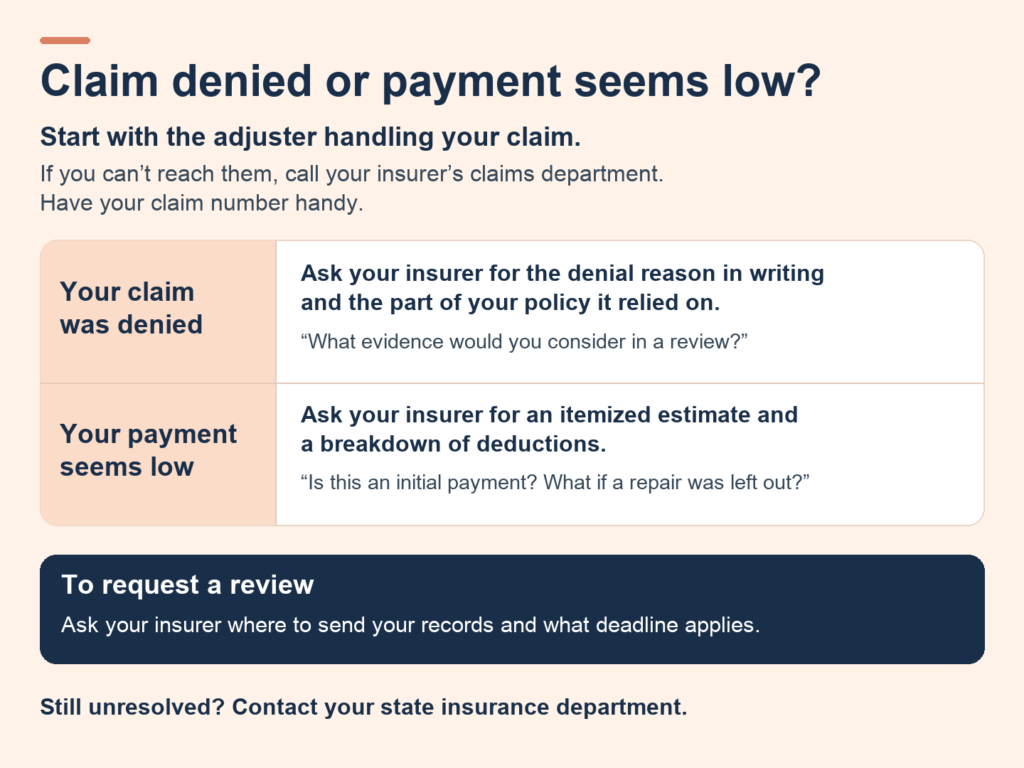
When you file a claim, it’s possible your insurer will deny coverage or approve a payment that’s lower than you expected. Either outcome can leave you wondering what happened, especially when you’re already dealing with repairs. Start by finding out how the insurer reached its decision.
If you have questions about the decision or the amount, start with the adjuster handling your claim. If you can’t reach them, call your insurer’s claims department and have your claim number ready.
What you ask for depends on what the insurer decided.
If the insurer denied coverage, ask for the reason in writing and the specific part of the policy it relied on. Say it denied your kitchen claim because of what it believes caused the water damage. You can ask what information it used to reach that conclusion and what evidence it would consider in a review.
If the insurer approved the claim but the payment seems low, ask for an itemized estimate and a breakdown of deductions such as your deductible or depreciation. Compare it with your contractor’s estimate to see if a specific repair was left out. Point to that line item and share any photos or records that support it. For a home claim, you can also ask whether the check is an initial payment and what to submit for any remaining eligible amount.
If you want the insurer to take another look, ask how to request a review, where to send your records, and what deadline applies. Keep the written decision, your claim number, and copies of what you submit. If you still can’t resolve the issue with your insurer, your state insurance department can explain how to file a complaint.
How Peachy Can Help
If you’re a Peachy customer and aren’t sure where to start after damage to your home or car, reach out to us. We can help you find the right place to report your claim and walk you through what to have ready. If you’ve already filed, have your claim number handy so we can point you to the right next step.
Coverage and claim payments are subject to policy terms, conditions, exclusions, and limits. The payment example is illustrative.

Renata holds a Master's in Communication and Marketing from ESPM (Escola Superior de Propaganda e Marketing) and a degree in Journalism and Social Communication from PUC Campinas. She holds HubSpot certifications in Content Marketing, Content Hub, Marketing Hub, and Answer Engine Optimization (AEO). She focuses on making insurance content clear, accurate, and easy to find.
When she's not working on Peachy's next article, Renata is cooking, catching live music, or exploring Brazil's natural landscapes.
- How Do Insurance Claims Work? A Step-by-Step Guide for Home and Auto - November 23, 2026
- What Is an Insurance Deductible? A Guide for Home and Auto - November 23, 2026
- 5 Insurance Coverage Gaps in Georgia - November 19, 2026
