

A hailstorm rolls through, and the next morning your car is covered in dents. You pull up your insurance policy and see a $500 deductible. What does that mean for the repair bill? And if the same storm damages your roof, will your home policy work the same way?
An insurance deductible is the amount your policy says you’re responsible for paying out of pocket toward covered damage when you file a claim. If the coverage you’re using has a deductible, your insurer subtracts that amount when it calculates your claim payment. Here’s how that works for your car and home, and how to check what you’d owe on your own policy.
How Does an Insurance Deductible Work?
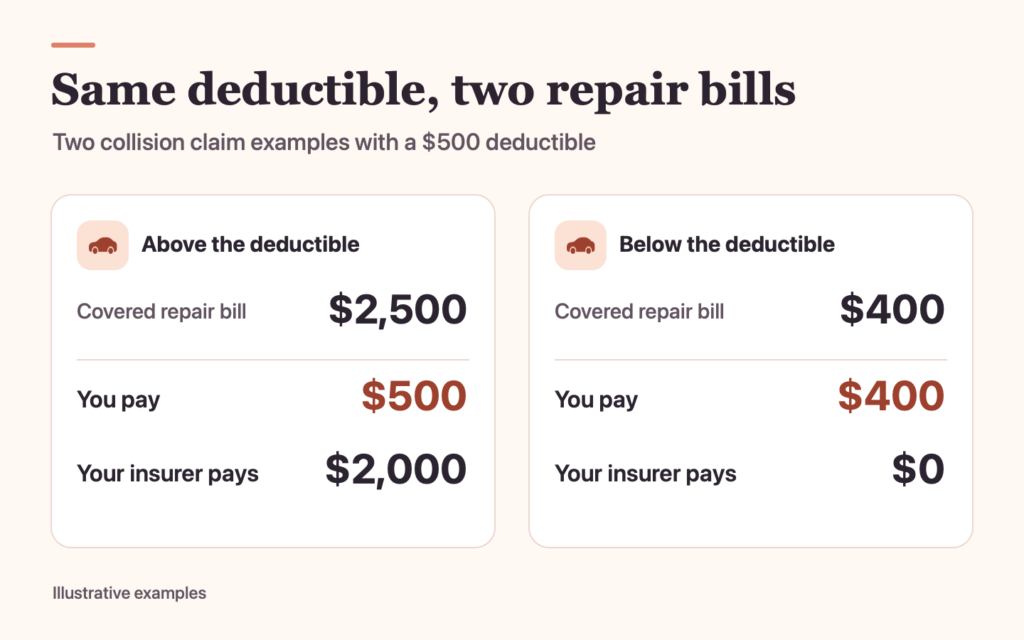
Let’s say you back into a concrete post in a parking lot and damage your car’s bumper. You file a claim with your insurer using your collision coverage. Your insurer confirms the damage is covered and approves $2,500 in repairs.
If your collision deductible is $500, the insurer subtracts that amount and pays $2,000. If the insurer pays the repair shop directly, you’d typically pay your $500 share to the shop.
Now imagine the same accident leaves only a scrape and the shop quotes $400 to fix it. Even if the damage is covered, the repair costs less than your $500 deductible, so you’d pay the $400 bill yourself. If the covered amount is equal to or below your deductible, there’s no insurance payment for that damage. If someone else was involved or there may be more damage than you can see, check your policy’s reporting requirements and contact your insurer promptly.
Home and auto deductibles generally apply to each separate covered loss. If hail dents your car in April and a collision damages it in September, a deductible can apply to each incident. If you’re used to how health insurance works, that’s an important difference. Health plans typically have an annual deductible that eligible expenses can build toward.
When Does a Car Insurance Deductible Apply?
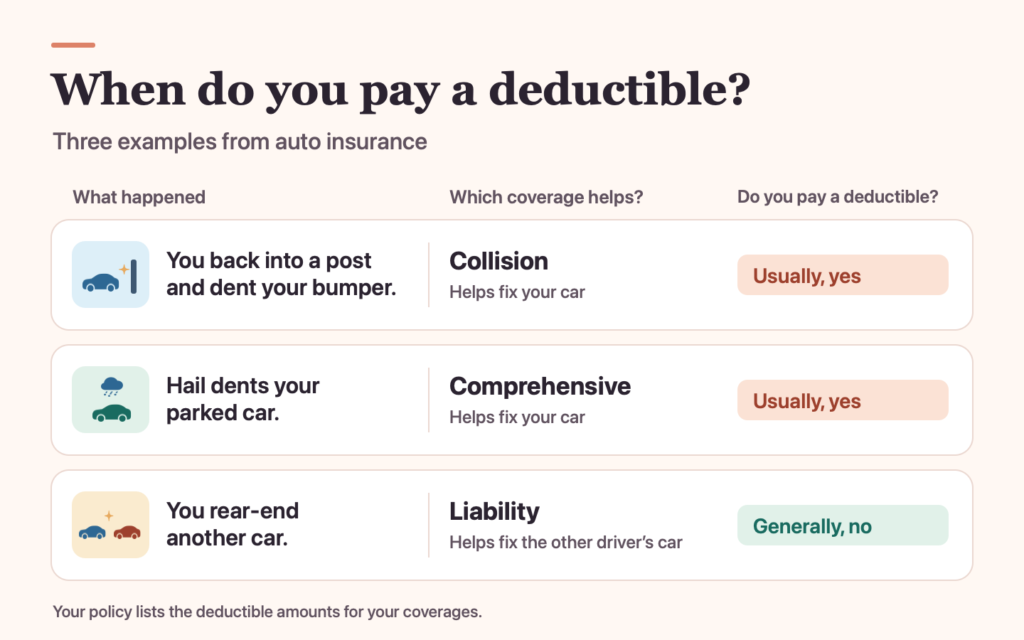
On your car insurance policy, the two deductibles you’re most likely to see are for collision and comprehensive coverage. Check both amounts for each vehicle on your policy because they can differ.
- Collision may help pay to repair your car if you hit another vehicle or an object, like a pole in a parking lot.
- Comprehensive may help pay for damage from things like hail, theft, vandalism, or hitting a deer.
Say you accidentally rear-end another car at a stoplight and both cars need repairs. If your auto liability coverage pays for the other driver’s repairs, that coverage generally has no deductible. If you use your collision coverage to fix your own car, your collision deductible generally applies to your repairs.
What to ask your insurance agent: What are the collision and comprehensive deductibles for each of my cars, and do glass claims have different rules?
How Does a Homeowners Insurance Deductible Work?
On a homeowners insurance policy, deductibles typically apply to covered damage to your home or belongings. Personal liability coverage generally has no deductible. For instance, a deductible would typically apply to covered damage from a kitchen fire. If a guest is injured at your home and your personal liability coverage applies, the property deductible generally wouldn’t apply to their claim.
Your home policy may list a flat dollar deductible, such as $1,000, or a percentage deductible. It may also have a separate deductible for certain storm damage, such as wind or hail. Check which events trigger it and what amount the percentage is based on.
Let’s go back to that hailstorm.
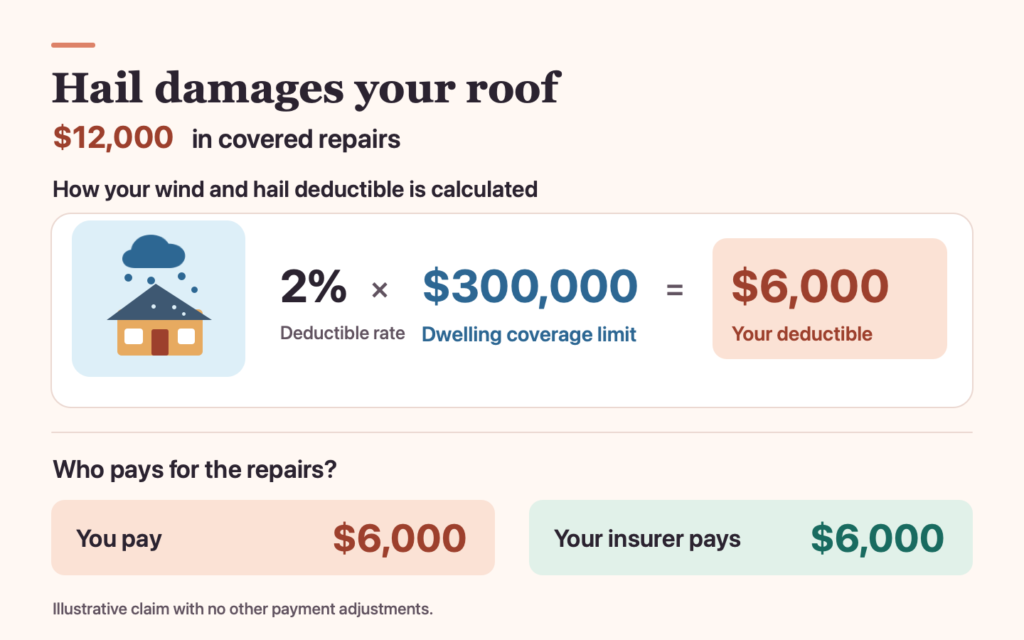
A roofer finds that hail damaged your shingles, so you file a claim with your homeowners insurer. Your insurer confirms the hail damage is covered, estimates the covered repairs at $12,000, and tells you your separate wind and hail deductible applies.
If that deductible is 2% of your $300,000 dwelling coverage limit, your share would be $6,000. Your insurer would subtract that amount from the $12,000 in covered repairs, leaving a $6,000 claim payment in this example, assuming there are no other adjustments.
The dollar amount is worth writing down. If your dwelling coverage limit goes up at renewal, a percentage deductible based on that limit can go up in dollars, too.
What to ask your insurance agent: Do I have a separate deductible for wind, hail, or other storm damage? When does it apply, and how much would I owe in dollars today?
Should You Choose a Higher or Lower Deductible?
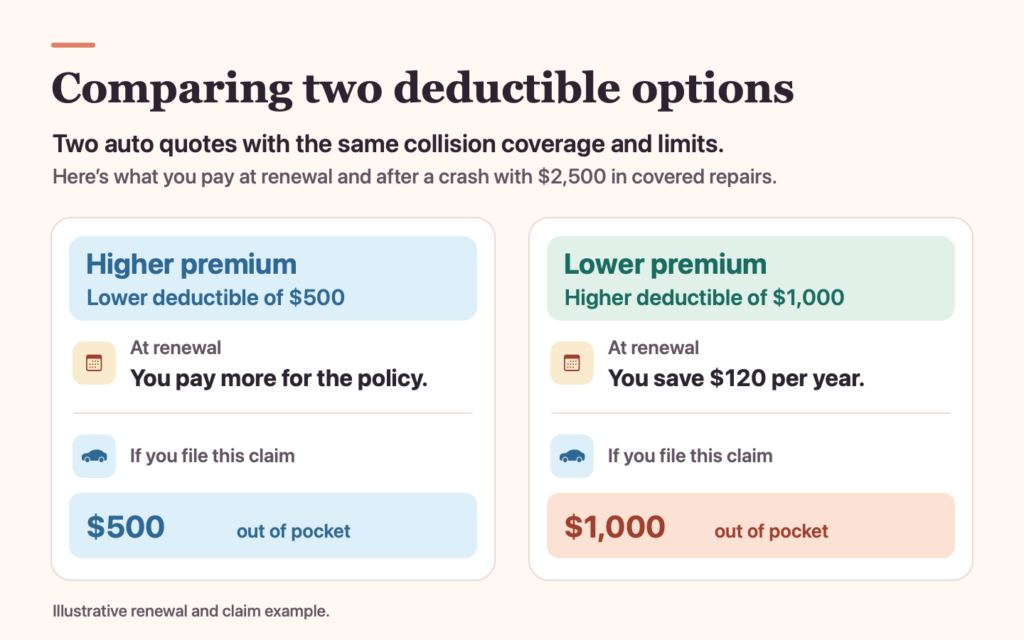
Your premium is what you pay to keep your insurance policy in place. Your deductible is what you’re responsible for when it applies to a covered loss. A higher deductible generally lowers your premium and increases what you’d need to pay after a claim. A lower deductible generally does the reverse.
Say your auto policy is up for renewal and you ask your agent to quote two collision deductibles with the same coverage and limits. The $1,000 option costs $120 less per year than the $500 option. That’s $10 a month in premium savings. If you later have a covered collision claim with $2,500 in approved repairs, you’d pay $1,000 toward the bill with the higher deductible or $500 with the lower one.
Then ask yourself a question you can answer without guessing when you’ll have a claim: If you needed to pay the higher amount next week, could you cover it comfortably?
It’s worth asking the same question about your home and car deductibles together, especially if one storm could damage both.
Where to Find Your Deductibles and What to Check
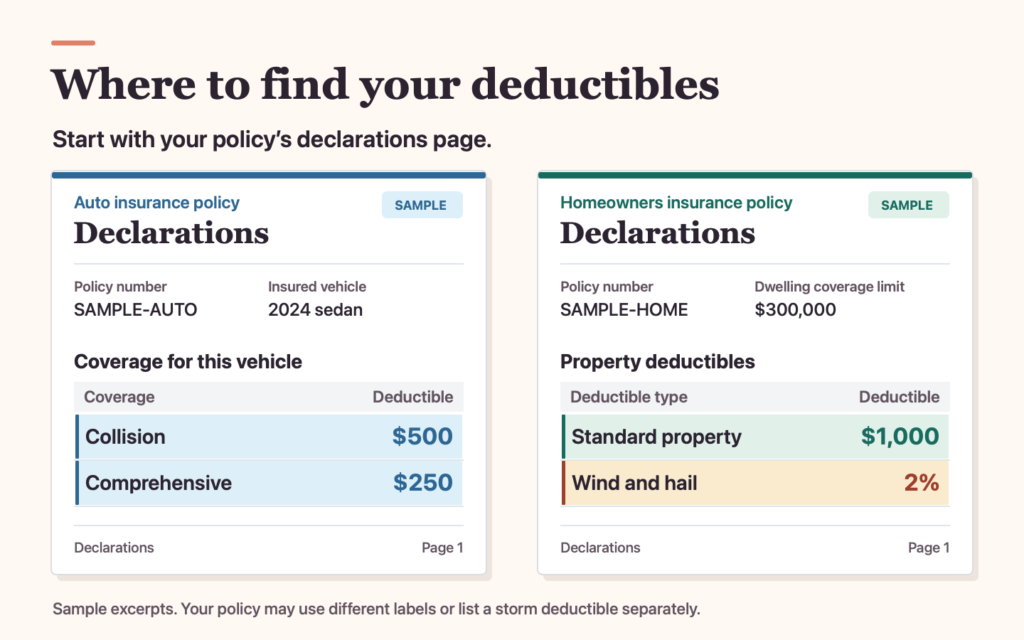
Start with your declarations page, often called the dec page. It’s the summary at the front of your policy that lists your coverages, limits, and deductibles. If you see a separate deductible or a reference to an endorsement, check the attached policy language or ask your agent when it applies.
- For your car, write down the collision and comprehensive deductibles for each vehicle that carries those coverages.
- For your home, look for the standard property deductible and any separate storm deductible. Convert each percentage to dollars using the amount specified in your policy.
- Before changing either policy, get the actual premium difference and make sure the amount you’d owe after a covered loss fits your budget.
Want Help Reading Your Policy?
If you find a deductible you don’t recognize, have your declarations page handy when you reach out. A Peachy agent can walk you through the amounts on your policy, explain when they apply, and help you compare your options if you’re thinking about making a change.
Talk to a Peachy Insurance Agent
Coverage is subject to policy terms, conditions, exclusions, and limits. Claim and premium examples are illustrative.

Renata holds a Master's in Communication and Marketing from ESPM (Escola Superior de Propaganda e Marketing) and a degree in Journalism and Social Communication from PUC Campinas. She holds HubSpot certifications in Content Marketing, Content Hub, Marketing Hub, and Answer Engine Optimization (AEO). She focuses on making insurance content clear, accurate, and easy to find.
When she's not working on Peachy's next article, Renata is cooking, catching live music, or exploring Brazil's natural landscapes.
- How Do Insurance Claims Work? A Step-by-Step Guide for Home and Auto - November 23, 2026
- What Is an Insurance Deductible? A Guide for Home and Auto - November 23, 2026
- 5 Insurance Coverage Gaps in Georgia - November 19, 2026
